
Your Questions Answered: Flexible Plastics Collection in Select Communities
Thank you for the strong response to the launch of flexible plastics collection in apartments and condos in Vancouver and homes receiving curbside collection in the Regional District of Central Okanagan (RDCO). These communities join West Vancouver and Maple Ridge in having collection of flexible plastics from home (either curbside or multi family).
We’ve carefully reviewed the FAQs and feedback received and below are some of the common topics raised, along with information to provide additional clarity and to help those interested understand how they can participate and continue making meaningful contributions to the program’s success.
Q: When will this be available for single-family homes and townhomes?
We know there’s a lot of interest in more convenient options for the collection of flexible plastics, and we’re working toward expanding this service to more households over time. While we don’t have a timeline or formal commitment to share yet, it’s an area of active interest. For now, the changes in the recycling collection were not made to exclude townhomes, duplexes, or similar housing types. Rather, the changes apply to existing multi-family properties that already receive multi-family recycling collection services in our program.
In the meantime, residents can play a meaningful role in the program’s success by continuing to divert recyclable flexible plastics from landfill by taking them to depots (https://recyclebc.ca/where-can-i-recycle/find-a-depot/) and in small quantities, at participating London Drugs stores.
Learn what goes where: https://recyclebc.ca/what-can-i-recycle/
Q: Which communities in BC are getting Flexible Plastics collection next?
While there’s no confirmed timeline for other communities to join yet, options continue to be explored. Right now, flexible plastics collection from homes is available in select communities including West Vancouver, Maple Ridge and Vancouver apartments and condos. In May 2026, homes receiving curbside collection in the Central Okanagan will also be onboarded. While there are no confirmed timelines for implementation in additional communities at this time, residents are encouraged to follow us online for updates and continue dropping off flexible plastics at depots and participating London Drug locations.
Find a depot: https://recyclebc.ca/where-can-i-recycle/find-a-depot/
Q: Do flexible plastics actually get recycled?
Yes. Flexible plastics are converted into pellets that are used to make new products such as packaging, pails, nursery plant pots, garbage cans, and lids. Once collected, flexible plastics enter the post-collection network where they are sorted, baled, and sold as commodities to approved end markets. Recycle BC’s standardized accepted materials list, strong promotion and education efforts, emphasis on source-separated and depot-only materials and advanced sorting technology all help ensure high-quality material that can be responsibly recycled.
Learn about the residential recycling process in BC: https://recyclebc.ca/learn/the-recycling-process/
Q: Does everything just get dumped overseas?
No. Recycle BC prioritizes keeping materials as local as possible. There are local BC end markets for plastic and glass, and metal and much of the paper remain in Canada and North America. Despite global market challenges, the program has maintained strong domestic outcomes by focusing on quality and reducing contamination. In 2024, 80% of materials were sent to North American end markets, up from 73% in 2023, demonstrating continued progress in keeping materials closer to home.
Learn about our end markets: https://recyclebc.ca/learn/the-recycling-process/end-markets/
Q: How much gets recycled vs. landfilled or burned?
The materials collected under Recycle BC’s program are not managed by incineration. Knowing where materials go after leaving our facilities – to be processed responsibly and ultimately back into the marketplace – matters to Recycle BC. We visit and verify our end markets to ensure material is being managed responsibly.
We invite you to have a look at our most recent Annual Report to learn about recovery rates for each material. Annual Reports are published in July of each year.
View Annual Reports: https://recyclebc.ca/about/annual-reports/
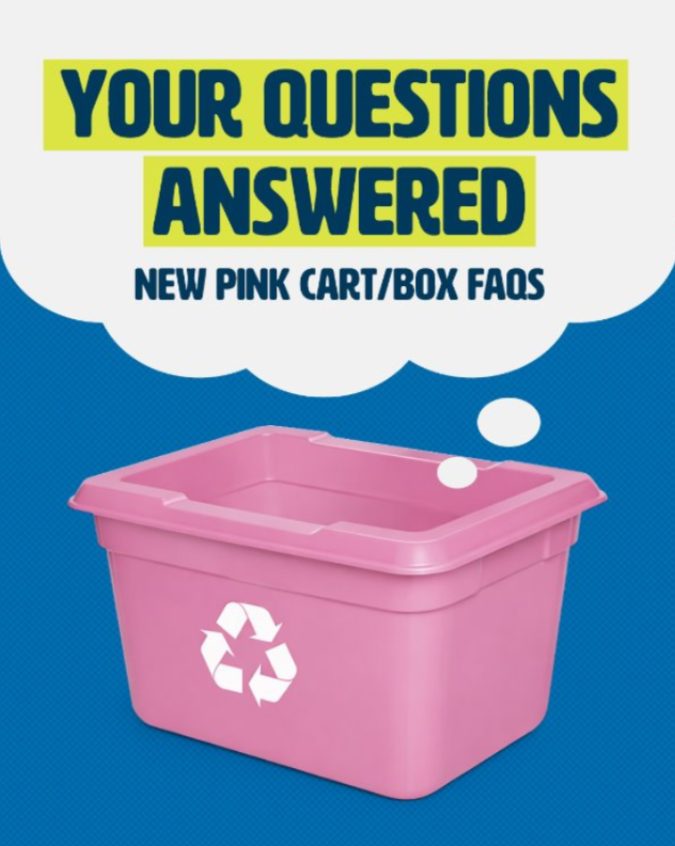
Q: Why the colour pink?
The pink colour was chosen intentionally to make the bin highly visible and clearly distinct from other recycling streams, helping reduce confusion and contamination. Recycle BC also has colours that are used for each material type and pink is the colour used for flexible plastics that’s consistent across signage, educational materials, website and more. It was a bold choice and we understand that the colour of the new collection bins may not appeal to everyone.
Our goal is to make recycling as simple and successful as possible for everyone, and the colour is one of the tools we use to support that. While we recognize that design preferences vary, we hope the bins become more familiar as people get used to seeing and using them.
Q: Are residents paying more for flexible plastics collection?
Residential recycling collection (aka: blue bin) across BC is not funded by residents through taxes. Recycle BC operates under an Extended Producer Responsibility (EPR) model, which means the program is funded and managed by the companies that produce packaging and paper supplied to homes in British Columbia. Under this policy approach, producers are financially and operationally responsible for these materials throughout their full life cycle, including end-of-life recycling.
More information about Extended Producer Responsibility can be found here: https://recyclebc.ca/about/extended-producer-responsibility/
Q: If chip bags and granola bar wrappers are accepted, how about tea bag wrappers, flower wrap or cellophane?
Due to the numerous types of packaging in market, it comes down to material composition. Some crinkly items are made entirely of recyclable plastic films, while others contain layers (e.g. paper, foil, or adhesives) that can’t be separated during processing. Here’s a breakdown of what’s accepted and what’s not currently accepted as flexible plastics, in our residential program in BC:
Cellophane:
- Not accepted (due to material composition)
- Commonly used on floral bouquets and gift baskets

Tea Bag Wrappers & Other Small Wrappers:
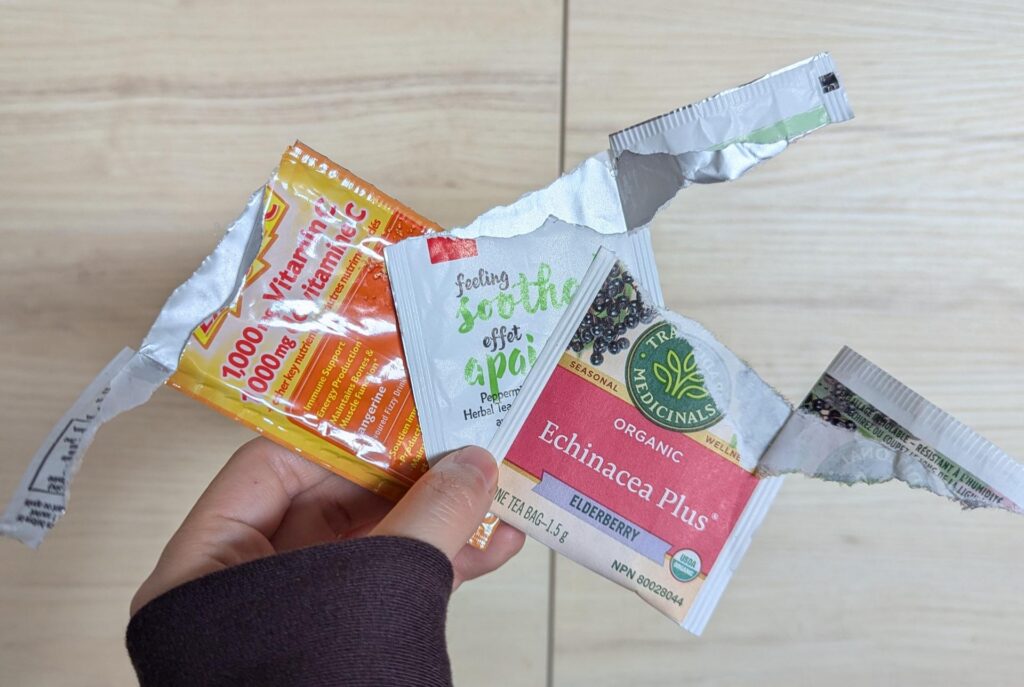
- Plastic and/or foil (no paper): Accepted under “Flexible Plastics” (depot-only, or in applicable communities now, the pink cart/box)
- Example: Vitamin packet shown in photo below
- Paper/plastic or Paper/foil: Not accepted
- Example: tea bag wrapper shown in the middle of photo below
- Paper only: Accepted under “Paper” (clean & dry)
- Example: tea packet shown on the right of photo below
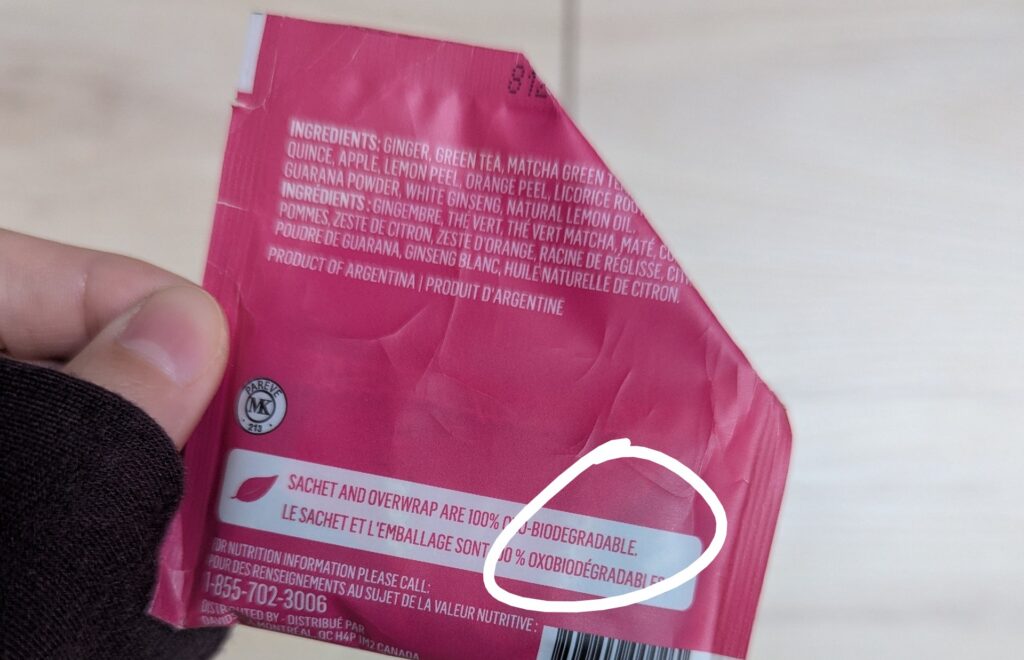
- Biodegradable or compostable: Not accepted
- Example: ‘biodegradable’ pink tea packet / sachet shown in the second image below
Full list of non-accepted items under Flexible Plastics:
- Items that are not packaging like
- Long term heavy-duty storage containers like plastic totes
- Plastic bags with cloth, rope, or ribbon handles (plastic bags are recyclable when cloth, rope or ribbon handles are removed)
- Carry-out bags with PVC/vinyl
- Packaging labelled biodegradable, compostable, or oxo-degradable
- Lumber or construction wrap
- Items designed for disposal (e.g., garbage bags, compost/leaf bags)
- Flexible 6-pack rings
- Plastic squeeze tubes
- plastic-lined paper and paper-lined plastic
- Crinkly cellophane wrap for floral arrangements, etc.
- Rigid plastic containers
For items not accepted in our residential recycling program in BC, we recommend avoiding products that have packaging that is not as readily recyclable (better yet, opt for zero waste), but when stuck with a piece of garbage, check with your waste service provider on whether those items are accepted in any of their program streams to keep out of landfills (e.g. organics).
Q: What happens when non-accepted items (contamination) make it into the bin?
Like all recycling programs, keeping contamination low is important. If bins are heavily contaminated, material may be removed or redirected, which is why proper sorting really matters. Clear signage and community education help ensure the material collected can actually be recycled.
Download poster here: https://recyclebc.ca/wp-content/uploads/2025/12/Recycling-Posters.pdf
Q: Why aren’t producers and retailers doing more?
In BC, producers (businesses that supply residential Packaging and Paper to BC residents) are actually responsible for funding and managing recycling through extended producer responsibility (EPR). Non-profit programs like ours exist because producers are required to manage the materials they put out in the market. Recycle BC runs the program to manage the material on behalf of the producers. We continue to work with producers, governments, and communities to improve systems and support designing packaging for recyclability and reduce unnecessary packaging over time.
Learn more about our ambitious recycling targets in our 5-year program plan:
- https://recyclebc.ca/about/regulation-and-program-plan/
- https://recyclebc.ca/wp-content/uploads/2025/09/Recycle-BC-Program-Plan-Aug-19-2025.pdf
Q: Why is recycling so complicated? Why not single-stream?
Different materials require different processing methods to be recycled effectively and efficiently. Most single-stream machinery is designed to identify containers and paper only, and though effective in their own regard, at-source separation of materials makes a significant difference in further improving quality and overall recovery rates, especially for items like flexible plastics that contaminate other streams or get stuck in processing machinery designed for other materials.
Building an effective, province-wide recycling system is a shared effort and evolving process that can advance over time as all parts of the system continue to align and grow together. We sincerely thank residents for their patience and adaptability as programs, guidance, and infrastructure continue to improve across BC, and for their role in helping spread accurate information and focusing on what truly matters: Active participation that keeps recyclable materials out of landfill piles and instead, in the correct recycling streams. Your effort has been essential for the system to function effectively, and has helped us come a long way over the last 10 years!
The positive impact of your direct efforts: